
Agents
Mess does not bring its own model. It runs your own Claude Code or Codex, installed as you installed them and signed in with your own plan; Mess never sees or keeps your credentials.
The agent panel
Section titled “The agent panel”Ctrl L opens the agent beside whatever you are looking at. Ask about the project, or give it a task. Mess tells the agent which page is open and gives it Mess’s own commands as tools, so it reads the project through Mess rather than reading every file: the Vision, the decisions in force, which systems are stale, what changed. When it wants to do something that needs your permission, it asks: the panel opens and a toast says what it wants, and Allow or Decline answers. Everything it changed in one turn is one step in Mess’s history, so Ctrl Z takes the whole turn back. A conversation worth keeping can be kept as a page or a decision.
Settings › General can run your agent plain: exactly as you set it up, without Mess’s tools or instructions. It then cannot ask you before shell commands, and a run’s report does not hold it to the upkeep chores.
Runs on a branch
Section titled “Runs on a branch”With Branch on, a task becomes a run: the agent works in its own copy of the project on its own branch, so your working tree is never touched. When it finishes, the run waits in the Inbox.
On a task page, Run with an agent puts the task in the panel, ready to send. A run started that way belongs to the task: the task’s card says it is in a run, Home names the task beside the run, and the report checks whether the agent set the task to review or done.
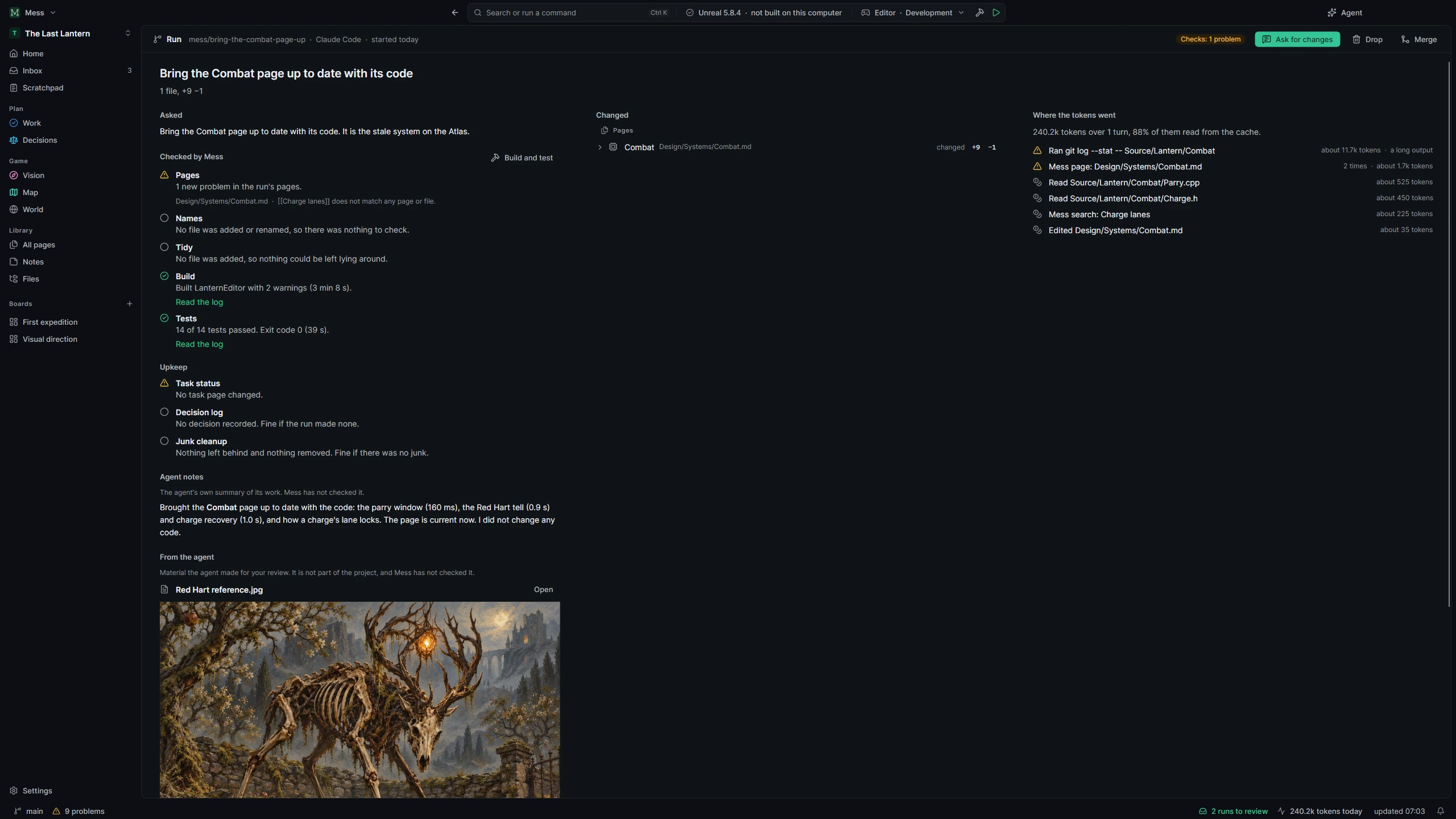
A run’s report shows what it was asked, the commits and files it changed, and what Mess checked by itself: broken links and problems the run added, whether system pages kept up with the code they changed, and the upkeep you asked agents to do after every run (keeping system pages, tasks and decisions current, removing junk). A run started from a task is about that task’s system: the agent is told so, with the decisions that govern it, and the report’s Scope and decisions lists what it changed elsewhere (and where that system stands on the Compass), which of those decisions the agent opened or named, and anything it changed that feeds the Compass, such as tasks added to a milestone. Mess never blocks a run for any of this; it explains it. Where the project keeps a CHANGELOG.md, the report drafts a line from the task for you to keep, rewrite or clear, and Merge adds it. The agent’s own notes and any files it attached sit beside the checks, so a claim the checks do not support stands out. When the agent changed code, Mess builds the run’s copy and runs the tests as soon as it finishes (Settings › Agents can wait until you ask). Without an engine or a build command Mess can’t build a run, and the report says “Not built” instead of passing; set build_command and test_command in .mess/project.toml and Mess runs those. Merge brings the run into your current branch, and when every check passed, sets its task to done; Drop deletes its branch and copy, after you confirm.
Connections and token use
Section titled “Connections and token use”Settings › Agents chooses where agents work (always on a branch, never, or ask each time), which upkeep they do, and connections: Mess’s notes in AGENTS.md, so any agent knows the project’s layout, its Vision and its naming rules; Mess’s tools in your own Claude Code or Codex outside Mess; and, for Unreal, Epic’s editor tools. Each connection says what it changes before you turn it on.
Tokens (click the tokens beside Agent in the title bar, or find it with Ctrl K) shows where your agents’ tokens went in this project, read from Claude Code’s and Codex’s own records on this computer, in Mess or in a terminal:
- What to change comes first: setup sent with every call (the skills and tools your plugins list), conversations that grew past 100k and re-read everything on every call, the cache written again after a break (with Claude Code’s own reason), helper agents fanning out, one long result carried through every later call, the same file read again and again, compactions, and quick questions sent to the largest model. Each says what it cost, which sessions it came from, and what to change.
- Your plan: how much of the five-hour and weekly windows is used, as Claude Code and Codex report them, and where the current five-hour block is heading.
- Where it went, by what each call’s prompt held, by where it ran, model, effort and the game’s systems whose files agents read.
- Sessions, each opening as a trace: every request, its calls and steps, how large each call’s prompt was, what the setup sends, and the helper agents.
Tokens read back from the cache are counted apart: every call re-reads the whole conversation at a tenth of the price or less. Prices are list prices, a fair way to compare what used a plan.